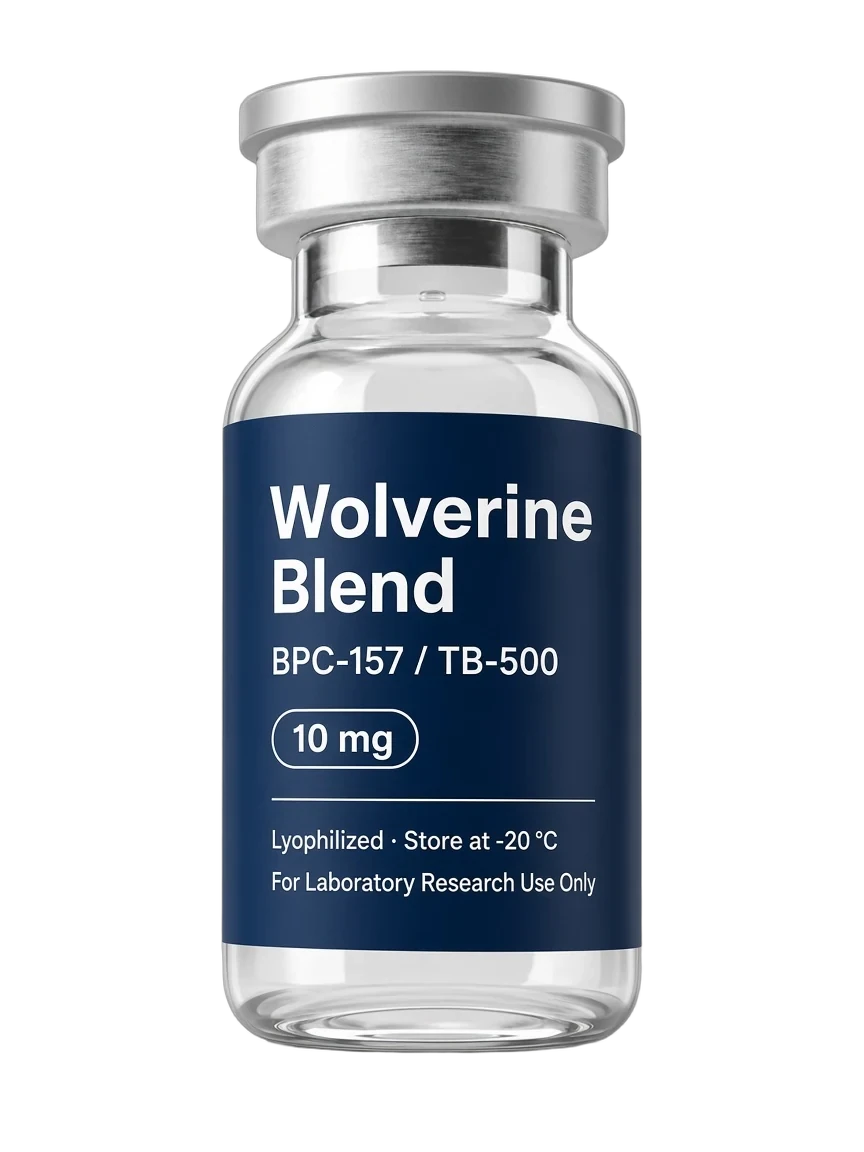
Laboratory research use onlyThird-party HPLC-UV tested · 99.59% purityLot White Cap · CoA on fileBPC-157 10 mg + TB-500 10 mg (20 mg total)Bundles of 1–4 vialsLyophilized · sealed glass vialLC-MS identity confirmed

Wolverine Blend is a lyophilized research vial labeled to contain BPC-157 10 mg + TB-500 10 mg (20 mg total). It is also called the Wolverine stack or Wolverine peptide. The current lot, White Cap, was tested by Freedom Diagnostics Testing (CoA accession #2608120749, reported 2026-08-17): HPLC-UV purity was 99.59%, LC-MS confirmed the identity of BPC-157 and Thymosin Beta-4, and measured net content was 11.74 mg BPC-157 and 9.78 mg Thymosin Beta-4. For laboratory research use only. Not for human or veterinary use.

Lot White Cap test results (Freedom Diagnostics, 2026-08-17)

Every figure below is read directly from the Freedom Diagnostics Testing report for lot White Cap, accession 2608120749. Reported 2026-08-17.

99.59%HPLC-UV purity, measured
11.74 mgBPC-157 net content per vial (labeled target 10 mg)
9.78 mgTB-500 (Thymosin β-4) net content per vial (labeled target 10 mg)
20 mgTotal labeled peptide per vial, lyophilized

What is in the vial: BPC-157 and TB-500 identifiers

Identity fields for the two co-packaged peptides, cross-referenced to the public databases (PubChem for BPC-157, UniProt for thymosin β-4). Per-lot values are on the supplier CoA.

Abstract peptide illustration, decorative only
Decorative illustration, not the actual molecular structure
Composition
BPC-157 + TB-500
Content per vial
BPC-157 10 mg + TB-500 10 mg per vial (20 mg total, lyophilized)
BPC-157 sequence
GEPPPGKPADDAGLV
BPC-157 formula
C62H98N16O22
BPC-157 PubChem CID
108101
TB-500 identity on the lot CoA
Thymosin Beta-4 (LC-MS confirmed), UniProt P62328
Presentation
Sealed glass vial, lyophilized powder
Storage
~2–8 °C short term; −20 °C or colder long term, protected from light

How research peptides are made and tested

A typical research-peptide workflow runs from synthesis to lyophilization. The lot CoA reports the two analytical steps: HPLC-UV purity and LC-MS identity.

  1. Synthesis

    Peptides of this kind are usually made by solid-phase synthesis, adding one residue at a time to a stated sequence.

  2. Purification

    The main product is typically isolated from synthesis by-products before assay.

  3. HPLC purity

    The lot CoA reports reversed-phase HPLC-UV purity as the integrated main-peak area.

  4. Mass-spec identity

    The lot CoA reports LC-MS identity by comparing observed mass with the expected mass.

  5. Lyophilization

    Research peptides are commonly dried under vacuum from a frozen sample and sealed as powder in glass vials.

  6. Sealed-vial dispatch

    The lot CoA is published on the batch documentation page. Move sealed vials to refrigerated or frozen storage on receipt.

Certificate of analysis for lot White Cap

Values below are from the Freedom Diagnostics Testing certificate for accession 2608120749.

Issuing laboratory
Freedom Diagnostics Testing
CoA accession
#2608120749
Received
2026-08-12
Reported
2026-08-17
Lot
White Cap
Product label
Wolverine 10mg/10mg/vial
Purity (HPLC-UV)
99.59%
Identity (LC-MS)
Confirmed: BPC-157 and Thymosin Beta-4
Appearance
White lyophilized powder

Measured net content on this lot: BPC-157 11.74 mg · TB-500 9.78 mg. Labeled per vial: BPC-157 10 mg + TB-500 10 mg (20 mg total). The COA identifies the second peptide as Thymosin Beta-4; it is the parent protein that the research peptide TB-500 is derived from.

Wolverine Blend FAQ

More questions are answered on the FAQ page.

What is Wolverine Blend?

Wolverine Blend is a common name for a lyophilized research vial labeled to contain BPC-157 10 mg and TB-500 10 mg (20 mg total). It is supplied for in vitro laboratory research only.

Is Wolverine Blend the same as the Wolverine stack?

Yes. Wolverine Blend, the Wolverine stack and the Wolverine peptide are three informal names for the same lyophilized BPC-157 + TB-500 research blend. The Wolverine stack page lists where the name is used.

What purity did lot White Cap test at?

Freedom Diagnostics Testing reported 99.59% purity by HPLC-UV for lot White Cap (accession 2608120749) on 2026-08-17, with identity confirmed by LC-MS.

Why does the CoA list Thymosin Beta-4 instead of TB-500?

The certificate reports the second peptide by its parent-protein name, Thymosin Beta-4 (UniProt P62328). It measured 9.78 mg of it in the tested vial, against a 10 mg label.

Why is the measured BPC-157 content higher than the label?

The label states 10 mg per vial. The lab measured 11.74 mg BPC-157 in the tested sample from lot White Cap.

How should it be stored?

Sealed vial: refrigerate at approximately 2–8 °C short-term; freeze at −20 °C or colder for long-term storage, protected from light. Full lab guidance on the storage and handling page.

What does the certificate of analysis cover?

Identity (LC-MS) and purity (HPLC-UV) for a specific lot, with the CoA accession and test date. See how to read a peptide CoA for the document layout.

Is Wolverine Blend for human or veterinary use?

No. Wolverine Blend is supplied as a laboratory research material. It is not a drug, dietary supplement or cosmetic, and it is not intended for human or veterinary use, or for diagnostic or therapeutic purposes.

Video: what the Wolverine stack is

Short research-material explainers from the Peptide Learn YouTube channel on what the Wolverine Blend vial contains. The video loads from YouTube only after you click. Research use only.

What Is the Wolverine Stack? BPC-157 + TB-500 Blend Explained. A research-material overview of what the Wolverine Blend vial contains and how the blend is documented. Research use only.
60-second explainer. What the informal “Wolverine stack” label actually refers to. Research use only.

More explainers on Peptide Learn on YouTube.